















Turning Building Data Into Sustainability Success

Philippa Gill
Real Estate Sustainability Advisor
We’re hearing lots about data - and now discover how it works for sustainable buildings! Join Philippa Gill and explore collecting, analysing, and using data for smarter building decisions.

We’re hearing lots about data - and now discover how it works for sustainable buildings! Join Philippa Gill and explore collecting, analysing, and using data for smarter building decisions.
Subscribe to watch
Access this and all of the content on our platform by signing up for a 7-day free trial.
Turning Building Data Into Sustainability Success
11 mins 21 secs
Key learning objectives:
Understand the importance of data in the built environment
Outline key types of sustainability data
Identify common challenges using sustainability data
Outline strategies to overcome challenges
Overview:
Subscribe to watch
Access this and all of the content on our platform by signing up for a 7-day free trial.
- Energy consumption: Measured via smart meters, Building Management Systems (BMS), or utility bills, capturing energy use, sources (on-site or purchased), and usage patterns.
- Water usage: Includes municipal, rainwater, or recycled sources, with efficiency measured via low-flow fittings, automated meters, and sub-metering.
- Waste and materials: Data on waste types (general, hazardous, recycled), diversion rates, and materials usage, often collected via waste audits, vendor reports, or on-site tracking.
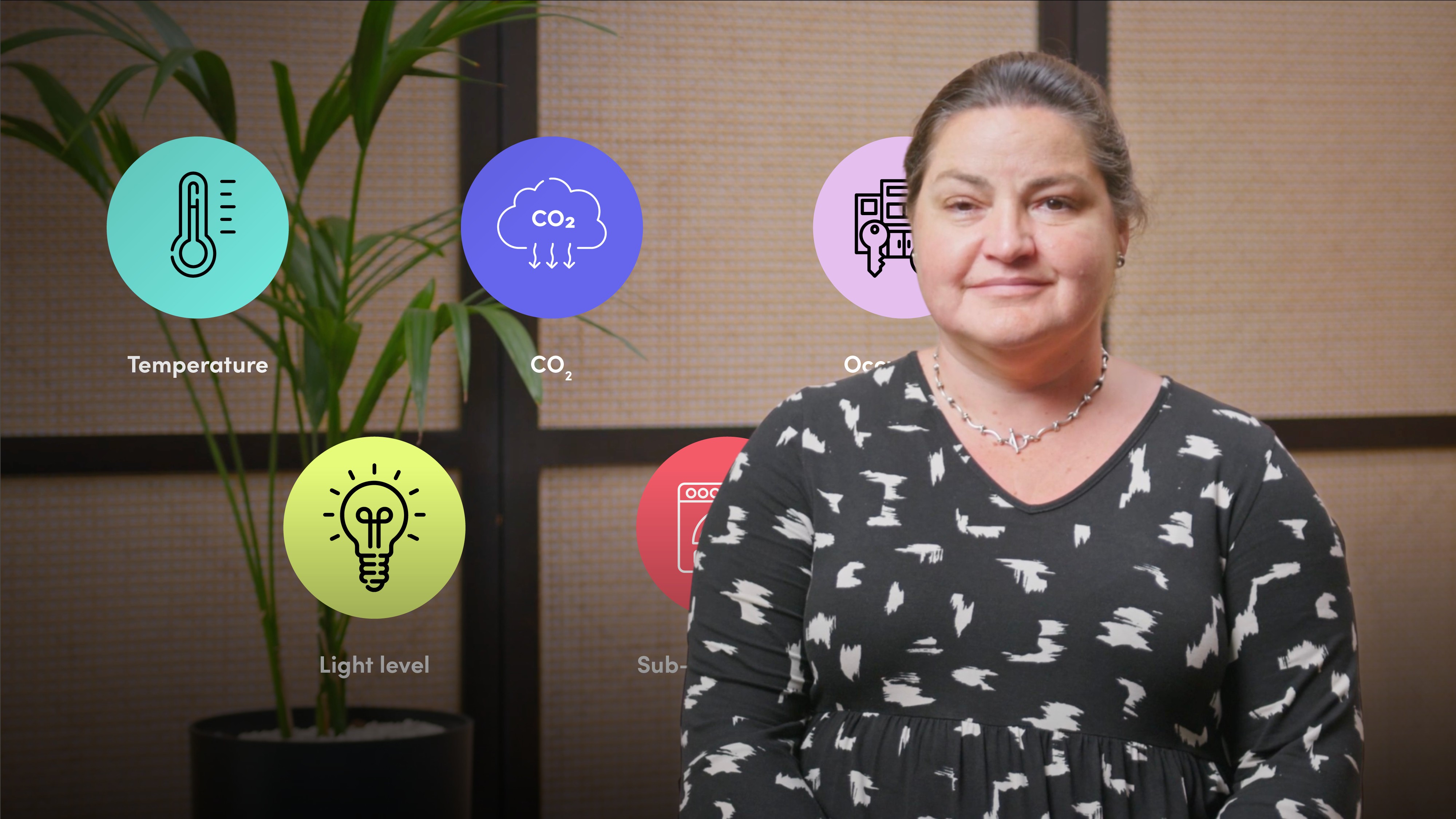
- Indoor environmental quality: Metrics include CO₂, particulate matter (PM2.5), VOCs, nitrogen oxide (NO), temperature, humidity, lighting, and noise, often collected via IoT sensors integrated with BMS.
- Carbon emissions: Calculated from operational data covering Scope 1 (direct), Scope 2 (indirect from purchased energy), and Scope 3 (other indirect emissions and embodied carbon). Lifecycle assessment (LCA) tools and sustainability software help quantify this footprint.
- Data quality and consistency: Meters may be untagged or incorrectly assigned, legacy systems may give inaccurate readings, and automated software can fail or produce systemic errors.
- Integration issues: Multiple platforms, software systems, and human inputs increase complexity, making it difficult to relate data directly to building performance.
- Granularity and completeness: Waste, materials, and water data can lack the level of detail needed for precise analysis, limiting the ability to track true sustainability performance.
- Evolving requirements: Sustainability metrics are increasingly mandatory for investment, disclosure, and regulatory purposes, raising expectations for accuracy, timeliness, and reporting capabilities.
- Regular audits, verification, and governance checks help ensure accuracy and consistency across all data streams.
- Sustainability metrics should be embedded into financial tools, reporting systems, and operational dashboards to support both compliance and decision-making.
- IoT, AI, and BMS platforms enable real-time monitoring, predictive analytics, and scenario modelling to proactively manage building performance.
- Consulting specialists when selecting data strategies and systems prevents costly mistakes and ensures long-term reliability.
Subscribe to watch
Access this and all of the content on our platform by signing up for a 7-day free trial.

Philippa Gill
There are no available Videos from "Philippa Gill"