














Your AI strategy is now an energy strategy

Maria Coronado Robles
Sustainability Content Principal
What if making AI more efficient doesn’t reduce its energy demand, but helps increase it?
We keep talking about making AI more efficient, and obviously, we should. Models are getting better at doing more with less energy, which sounds exactly like what we need. But making something more efficient doesn’t always mean we end up using less of it.
And we’ve seen this before, when flying becomes cheaper, we fly more and when cars become more fuel efficient, we drive more, even for journeys we could walk. AI could follow the same pattern. If a model uses half as much energy to do the same task, that’s a massive improvement. But if we start using it ten times as often, total energy demand still goes up.
Economists have a name for this: the Jevons paradox. It goes back to steam engines, when greater efficiency led Britain to use more coal, not less. As coal became cheaper to use, demand grew.
More than 150 years later, we may be watching something similar happen with AI. Except AI isn’t scaling alone. More AI means more data centres, electricity, chips, cooling, materials and water. And it is happening just as we’re asking the electricity grid to electrify cars, buildings and industry.
Which raises an increasingly uncomfortable question: when everyone needs more electricity, who gets it first?
AI joins the queue, or will it perhaps jump it?
AI is arriving at a grid that already has a queue. Cars, buildings and industry all need more electricity as they electrify. But new renewables, transmission lines and grid connections can take years to build.
In the US, a new data centre can wait more than four years for a grid connection. In Europe’s most congested infrastructure hubs, that queue can stretch to an agonising seven to fifteen years.
Billions of dollars of cutting-edge software are ultimately dependent on a physical grid designed for a very different world.
As if speed wasn’t enough, not everyone in this queue has the same chance of getting to the front, the big Tech has a VIP pass. They are signing massive long-term power deals, financing new generation, and investing directly in the physical infrastructure they need to bypass the public grid entirely.
In the US, more data centres are now built with their own gas power, creating little energy islands that can switch on without waiting years for a grid connection. Similar things are happening elsewhere, with a combination of gas and emerging alternatives such as hydrogen in parts of Europe, and LNG in parts of Asia.
AI can finance clean energy, so why is it building gas?
Tech giants have the capital to fund a huge expansion in clean energy. But at the same time, their growing energy needs are keeping existing fossil-fuel plants running and driving demand for new ones.
The problem is speed. AI demand is growing incredibly quickly, while wind and solar alone cannot always provide the constant, 24/7 power hyperscale data centres require. Better batteries and other forms of energy storage will change that equation, but they cannot solve every constraint today. As a result, fossil fuels are still expected to feed more than 40% of the additional electricity data centres will need by 2030.
What happens when you need massive amounts of electricity, 100% of the time, and ideally is low-carbon? Suddenly, nuclear power looks incredibly attractive.
Some of the world’s biggest technology giants are now looking into nuclear power. Microsoft, Google, and Meta are signing nuclear deals. Some are buying power directly from existing plants, others are financing the resurrection of decommissioned reactors, and others are betting heavily on Small Modular Reactors (SMRs). These reactors can theoretically be shipped on the back of a truck or train straight to a data centre. If the server farm grows, they simply order another reactor.
Whether AI becomes a green accelerator or a climate disaster depends entirely on what infrastructure is built, how fast it rolls out, and who gets to use the power.
What choices can AI users make?
Many companies now have an ambitious AI strategy and an ambitious climate strategy. They were probably written by different teams, in different rooms. But increasingly they depend on the same electricity, grid capacity, materials and capital. And we are already seeing those parallel ambitions collide. Some of the big tech companies are openly admitting they will struggle to meet their climate targets.
Microsoft's target to become carbon negative by 2030 is looking increasingly improbable as the massive energy demands of the artificial intelligence boom drive its greenhouse gas emissions upward, resulting in a 25% jump in a single fiscal year. Same goes for Google, its newest climate disclosures show that AI data centres are threatening its net-zero goals.
But AI and climate ambition don’t have to be enemies. AI could help optimise electricity grids, discover new materials, improve climate modelling, reduce waste and accelerate solutions that might otherwise take years.
Which is why we need to be much more deliberate about what we use it for and how, and whether the value it creates justifies the resources behind it. Using significant computing power to improve a grid or discover a new material is fundamentally different from using it for something with very little value. And those demands can vary enormously depending on the model, the task and what powers it.
However, businesses have remarkably little information to distinguish between those impacts. You can compare AI models by price, speed and performance in seconds. Try comparing them by electricity, water or carbon and suddenly you need James Bond.
Until that visibility improves, companies can at least be more deliberate about what they scale. Not every task needs the largest model available. Some may not need generative AI at all.
So three simple questions are worth asking:
- Does this task need AI?
- Does it need this much AI?
- Is the value we create worth the resources we use to create it?
If you can't control the footprint yourself, what can you do?
Individually, you genuinely can't control most of what drives AI's footprint — which model a vendor runs, where it runs, or what powers it. That can feel discouraging. But you're not limited to your own usage.
The biggest lever is your organisation, and organisations respond to the people in them. When you raise the question — in a vendor review, a procurement conversation, or just a team norm — you turn a personal concern into a business requirement. Companies that put energy, emissions, and transparency questions into their RFPs and contracts are exactly what pushes AI providers to clean up. So speak up: that's how "I can't do much" becomes "our company expects better."
AI strategy is no longer just a technology strategy. The moment AI starts competing for electricity, infrastructure and materials, it becomes a climate strategy too. If you're a company buying AI tools rather than building them - your ChatGPT or Copilot subscription, for example - that footprint doesn't just disappear. It shows up in your own emissions accounting, under what's called Scope 3. And those cost, reputational, and availability risks could bubble up to you too.
So what does responsible AI actually look like in practice?
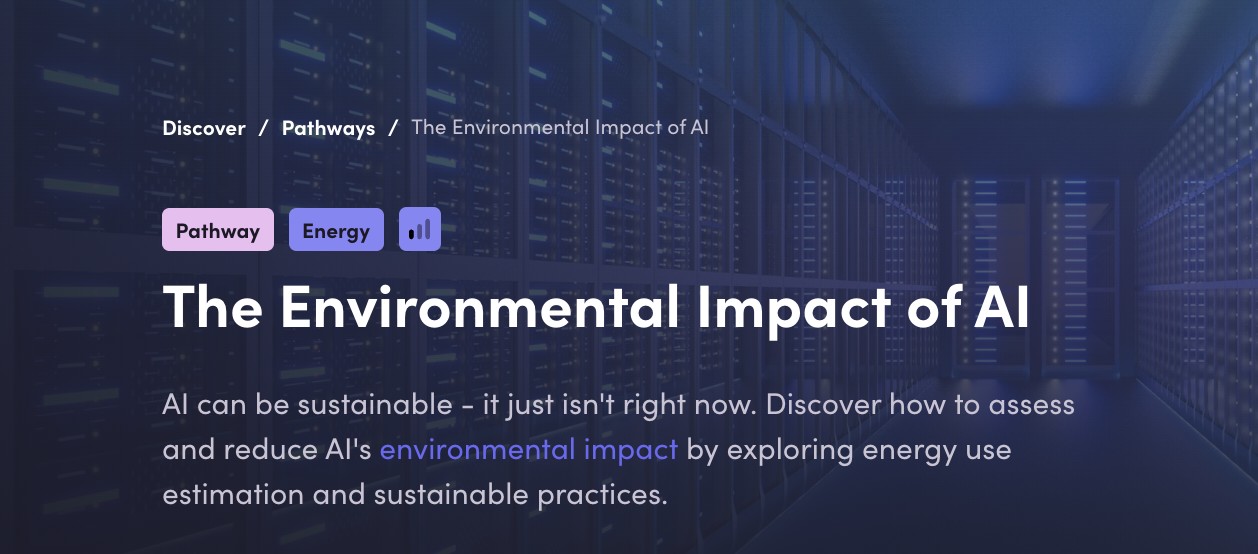
Boris Gamazaychikov, Co-Founder and CEO of Sustainable AI Group, explores the choices businesses can make, from which models we use to where and how we use them, in our new The Environmental Impact of AI pathway.

Maria Coronado Robles
Share "Your AI strategy is now an energy strategy" on
Latest Insights

El Niño: Everyone is talking about it. But what does it actually mean for your business?
1st October 2026 • Maria Coronado Robles

Sustainability training for employees: a practical guide for organisations
21st June 2026 • Learning Adviser