












The strategic repositioning of sustainability

Maria Coronado Robles
Sustainability Content Principal
As geopolitical shocks reshape the global economy, sustainability is emerging as the decisive lever of security, resilience, and competitive advantage.
Sustainability is undergoing a profound repositioning. It has moved past the “Force for good” narrative that dominated the past decade. In 2026, it is being defined as a critical tool for geopolitical competition. It is no longer just about reputation and corporate values, it is about strategic autonomy, economic protectionism and competitiveness.
This shift is driven by a collision of wars, energy shocks, and unprecedented technological acceleration. In an era where resource access is being weaponised, sustainability has emerged as the primary mechanism for decoupling from global price shocks and securing supply chain resilience.
By prioritising circularity and renewable independence, organisations are doing more than meeting environmental targets, they are insulating their operations against a fragmented global landscape. In this environment, "green" is becoming synonymous with "secure".
This transition from values to security, however, creates a new strategic bottleneck. Decoupling from global shocks and building industrial resilience cannot be achieved by a siloed department. It requires a workforce capable of turning high level strategy into granular operational reality. We have moved from the era of “awareness” to the era of “Execution” where the ultimate competitive advantage is no longer a bold target, but the collective skill to deliver it.
A world defined by energy shocks
For decades, "going green" was framed as a moral choice. Today, with Brent crude reaching close to $120 a barrel, it looks far more like a security and economic necessity. As UN Secretary General António Guterres put it, “You cannot blockade sunlight, and you cannot weaponize the wind”.The March 2026 blockade of the Strait of Hormuz served as the definitive tipping point. With 20% of global oil and one fifth of LNG disrupted after the U.S.–Israeli strikes on Iran, the “green transition” shifted overnight from a climate goal to a survival mandate as Europe and Asia now face what could be their worst energy shock since the 1970s.
This is not the first shock. Russia's 2022 full-scale invasion of Ukraine triggered Europe's first major energy crisis. Since then, the EU’s reliance on Russian gas has fallen from 45% of imports to 12% in 2025. This shift was codified by the historic political agreement reached in December 2025, which integrated the phase out of Russian fossil fuels into the REPowerEU framework. With a ban on Russian LNG by the end of 2026 and pipeline gas by late 2027, the transition is no longer just a roadmap, it is a binding mandate for member states.
According to the Climate Change Committee’s (CCC) landmark 2026 report, reaching Net Zero is now officially cheaper for the UK than a single fossil fuel crisis. With every pound invested in the transition yielding between £2 and £4 in benefit, this isn't just about carbon.
Sustainability is increasingly viewed as the only viable economic strategy. Moving to renewables is as much about energy security as it is about carbon. Resilience now means localising supply chains or reanchoring them in trusted, politically aligned countries to eliminate the risk of sudden geopolitical disruption.
From climate targets to industrial strategy
Energy shocks have forced a rethink of what the green transition actually means. What began as climate policy is now becoming industrial policy. Across Europe, the conversation has moved beyond decarbonisation targets to industrial capability and acceleration. The European Green Deal, launched in December 2019, largely defined the destination: legal climate targets and the roadmap to 2050. The focus now is the execution.
The Clean Industrial Deal, introduced in February 2025, shifts attention to the practical question of how the transition will be delivered. The emphasis is on scaling clean technologies, reducing energy costs and strengthening European industry while maintaining competitiveness. The objective is not only to reduce emissions, but to build a new industrial engine for the continent.
This direction became even clearer in March 2026 when the European Commission presented the proposal for an “Industrial Accelerator Act (IAA)”. The proposal introduces "low-carbon" and "EU origin" requirements for public procurement. It is about ensuring that the billions spent on the transition stay within the European economy. The IAA sets an ambitious goal to increase manufacturing's share of EU GDP to 20% by 2035 (up from 14.3% in 2024).
The evolution of the IAA’s name is very telling. Originally discussed as the “Industrial Decarbonisation Acceleration Act,” the word "decarbonisation" was dropped from the title. Some view this as a deliberate greenhushing tactic, where governments and companies continue heavy investment in decarbonisation but speak of it less publicly to broaden political appeal. But in reality, this reframes the mandate, it is no longer just a plea to "be green," but a demand to "prove you’re green or no contract”.
Ultimately, Europe’s repositioning reflects a new reality where environmental performance and economic resilience are inextricably intertwined. However, it is unfolding against the backdrop of a growing strategic divergence between the world’s two largest Western economies.
While Europe doubles down on clean energy as a survival mechanism, the U.S. under the Trump Administration is prioritising industrial sovereignty, directly prioritising fossil fuels as the primary engine for it. Through the One Big Beautiful Bill Act" (OBBBA), Washington has redirected green subsidies toward legacy assets. In March 2026, the Department of Energy launched the UPRISE Initiative, backed by $289 billion in loan authority to quadruple U.S. nuclear capacity.
Between these two models, organisations must decide where to anchor their supply chains. This choice is no longer just about energy. The same reframing is visible beyond climate policy. The UK government’s Nature Security Assessment, published in 2026, describes biodiversity loss and ecosystem collapse as national security risks because of the potential consequences for food systems, supply chains and economic stability.
When natural systems degrade, they trigger cascading economic shocks. This isn't just a headache for governments, but also a direct threat to corporate longevity. I explored how this macro-risk translates into a micro-strategic liability in my recent article on natural capital, the 'missing' risk that businesses can no longer afford to ignore.
In this new landscape, environmental performance, technological capability, and economic resilience are no longer separate departments. They are the new baseline for global competitiveness at a critical global turning point.
Organisations recognise the shift but struggle to execute
While policies set the pace, individual organisations are discovering that the distance between high level ambition and operational execution is wider than anticipated. The pivot to a 'Made in Europe' cleantech base requires a massive workforce recalibration that is currently ringing alarms in Brussels. Even if permits can be fast tracked, many companies still struggle to find the engineers, technicians and systems architects required to run next‑generation plants. The EU "Union of Skills" initiative, is a direct response to these bottlenecks in strategic sectors such as cleantech and automotive.
The scale of the challenge signals that we have entered what can only be described as the Era of Execution. This shift was unmistakable at this year’s Sustainability Week in London, which held dedicated summits on Carbon Capture, biodiversity and Sustainable Procurement, focussed on the operational bottlenecks of the transition. As highlighted by Celeste Saulo (secretary-general of the World Meteorological Organization), data transparency and climate forecasting are now essential boardroom tools for navigating global volatility and ensuring long-term business viability.
This shift also dominated the conversations with practitioners during a Sustainability Unlocked dinner we hosted alongside the Economist event bringing together professionals from banking, infrastructure and industry. Sustainability is increasingly interpreted through the lenses of business risk, financial performance and commercial opportunity, rather than environmental responsibility alone.
Yet, a recurring challenge haunts the transition: how can we translate these strategic moves into financial value recognised by investors? Many organisations understand the why of the "Clean Industrial" shift, but they are still struggling with how to:
- Prove that sustainability pays back in the short term?
- Accurately quantify the "avoided cost" of future carbon taxes?
- Ensure green products capture immediate market share?
Ultimately, the organisations that will lead the next decade are not those with the loudest promises, but those that can prove sustainability is their greatest driver of long-term value creation.
The skills paradox and The Twin Transition
We are now witnessing a "Skills Paradox" that threatens to stall the global transition. While 90% of organisations have established sustainability targets, the Sustainability Transformation Monitor 2026 report reveals an implementation gap. Ambition is concentrated in central leadership, but the capability to execute is missing on the front lines.
The real bottleneck is in the "execution layer." Sustainability strategy often remains trapped in small central teams. However, the decisions that determine a company’s environmental footprint are made every day by procurement (scope 3), engineering (materials), and finance (capital flow).
Fewer than 3% of leaders believe their workforce currently has the green skills to deliver on these commitments. This lack of "functional depth" means that those making the most critical decisions are often unequipped to act with confidence.
The result is a widening talent gap. Demand for green skills is growing twice as fast as supply (8% vs 4% globally). But the solution isn't just hiring more "Sustainability Heads." The LinkedIn Green Skills Report 2025 highlights a massive shift. For the first time, 53% of green hires are professionals in non-green roles (accountants, engineers, and buyers). The premium for this talent is high, workers with these skills are being hired at a rate 47% higher than the rest of the workforce.
This capability gap is further complicated by the "Twin Transition", that refers to the integration of Digital Innovation (AI, IoT, Digital Twins) and Sustainability. In 2026, sustainability and digital literacy are codependent. If you’re not digitally literate, you might struggle to be sustainability literate.
Scope 3 management requires sophisticated data capabilities across supply chains. Factory optimisation depends on the digital systems that monitor and manage energy use. Even software development carries environmental implications, as the efficiency of algorithms influences the energy consumption of entire digital networks.
A similar capability gap is emerging around AI governance. Although the EU AI Act was adopted in August 2024, many organisations are only now beginning to understand the operational implications. With penalties comparable to GDPR, companies are rapidly building internal AI compliance teams and developing new literacy requirements across functions. The message is clear: managing sustainability and managing AI risk will increasingly require the same organisational capability, data governance and workforce literacy.
Another risk emerging from the digital transition is what the UN Development Programme has described as the “Next Great Divergence”. As artificial intelligence spreads across economies, countries are entering the transition from very uneven starting points. Those with strong digital infrastructure, compute capacity and technical talent will capture the majority of the economic gains, while others may face labour disruption without the same productivity benefits. In this sense, the AI transition risks widening global economic gaps in much the same way that earlier industrial revolutions did.
The implication for organisations is clear. As both the sustainability and digital transitions accelerate, the demand for hybrid capability will intensify.
The shift is triggering a fundamental mutation in the global talent market. We have moved past the era of “sustainability awareness” where success was measured by a workforce understanding the why of climate change. We have now entered an era of “functional industrial literacy”. This is the so-called execution or implementation gap that requires hybrid expertise.
The risk, of course, is that in our haste to build this "industrial engine," we lose the ecological North Star. But for the organisations that can bridge this gap, those that can turn high-level ambition into functional, technical reality, without sacrificing environmental integrity, the reward is a seat at the head of the new global economy.
The Real Transition Is Organisational
The traditional model of the "Sustainability Department" has officially reached its limits. For years, these teams have been trapped in an impossible position of doing the job often without the capital, the integrated data tools, or the cross-functional authority to actually move the needle.
While many leadership teams are still asking where sustainability "sits", the reality has become undeniable: it sits everywhere. The central sustainability team is no longer there to "do" the work of the transition. Instead, their role has evolved into that of an enabler and a catalyst. This shift doesn't make the sustainability profession less necessary, it is a central role, perhaps more so now than ever. It is no longer just a department, they now hold the mandate to redefine how every other department creates value. This is the role the function was always intended to hold.
On the other side, responsibility for outcomes is migrating to the functions that own the decisions. Procurement, operations, finance, and IT are the true engines of the transition because they shape the operational reality of the firm. The sustainability transition is not a just technological challenge, it is an organisational challenge. Strategies do not implement themselves, people do. In this new landscape, the real competitive advantage is no longer having the most ambitious target; it is having a workforce with the functional depth to act with confidence.
- Procurement: Choosing suppliers based on carbon intensity as a standard professional judgment.
- Engineering: Selecting materials based on embedded impact and circularity.
- Operations: Optimising sites for energy resilience and waste reduction.
- Digital/IT: Building the data infrastructure that makes environmental performance visible and manageable.
Capability building in 2026 is about role specific understanding and integrated decision rights. Ensuring that a software engineer understands how their code influences the energy consumption of a network, or a finance director understands how to model transition risk into capital allocation.
The data supports this shift: over half of green hires in 2025 were professionals in roles not traditionally thought of as "green". These are traditional experts who have simply added a sustainability layer to their professional toolkit.
The transition is less about creating new sustainability roles and more about equipping existing roles with new capabilities. The firms best prepared for the next phase are those in which people across all functions understand how sustainability sits within their own daily decisions.
The choice for leadership is now binary: you either build this capacity internally, or you remain dependent on a shrinking, expensive external talent pool. In an era where sustainability is an economic and industrial challenge, capability building is the only strategy that will deliver execution.
Sustainability is no longer a side project, it is the engine of the new economy. The only question remains: is your workforce equipped to drive it?
How to turn sustainability into an operational reality
As sustainability moves into execution, organisations must equip cross-functional teams with the knowledge and judgement to translate strategy into the decisions they make every day.
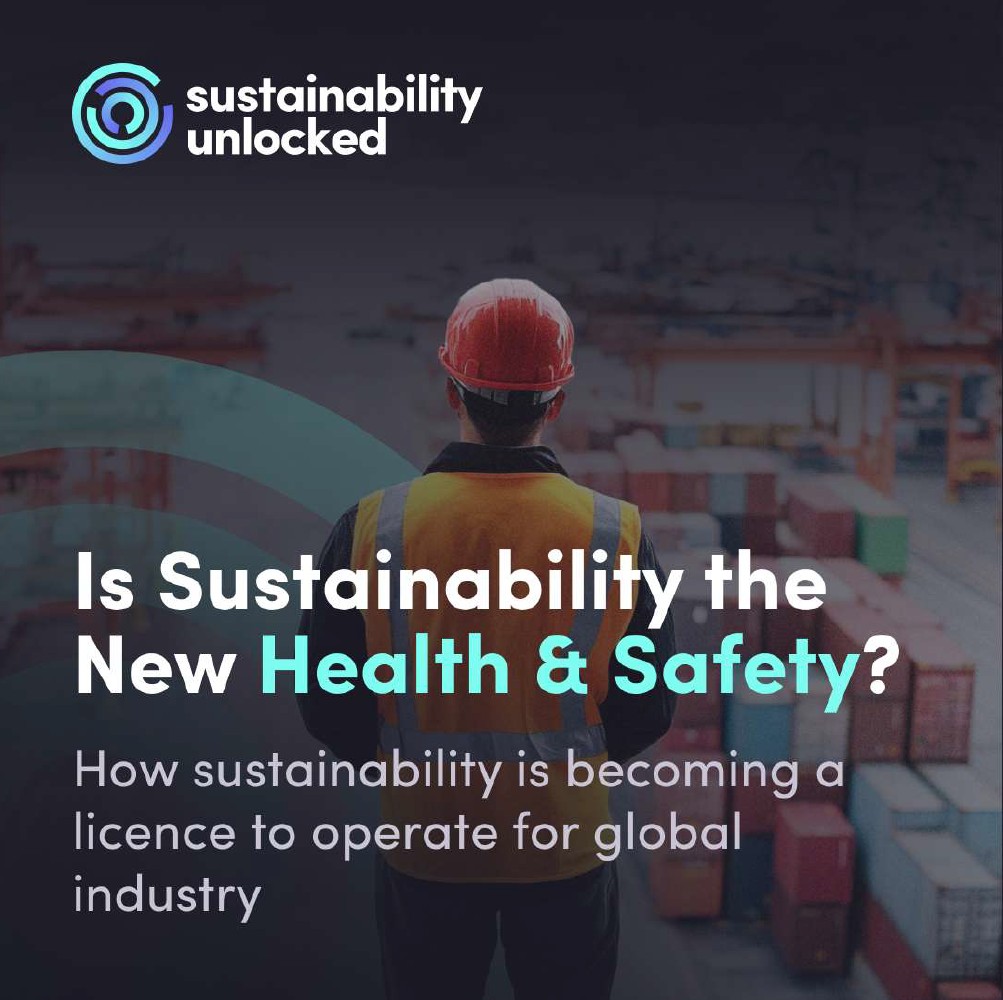
Our latest report, Is Sustainability the New Health and Safety? How sustainability is becoming a licence to operate for global industry, explores how this transition is unfolding across industry.
How is Scope 3 repositioning sustainability at the heart of the operating model? And how can organisations build the workforce capability needed to turn ambition into action?
Download the full report and find out how to equip and mobilise your organisation for the transition.

Maria Coronado Robles
Share "The strategic repositioning of sustainability" on
Latest Insights
El Niño: Everyone is talking about it. But what does it actually mean for your business?
1st October 2026 • Maria Coronado Robles
Sustainability training for employees: a practical guide for organisations
21st June 2026 • Learning Adviser