














COP31: What it means for your business

Maria Coronado Robles
Sustainability Content Principal
Why a UN climate summit could change your costs, suppliers and loans.
COP31 is the 2026 UN climate summit, held in Antalya, Türkiye, from 9 to 20 November 2026. Türkiye hosts and presides; Australia runs the negotiations. Even voluntary COP31 pledges can change what your business pays for energy, which suppliers you can use, how banks price your loans and which rules apply, such as the UK's carbon border charge from 1 January 2027.
If COP gives you a sense of déjà vu every year, you're not alone.
For three decades, nearly 200 countries have gathered at the annual United Nations climate summit, known as COP (Conference of the Parties), to negotiate how to respond to climate change. And for those three decades, they have systematically failed to stabilise a crisis that keeps worsening, usually wrapping up with a predictable round of applause over another "historic" agreement.
Meanwhile, outside the negotiation walls, global emissions remain stubbornly high, and the planet continues to warm. Just this October, devastating floods swept through parts of Spain. Severe flooding has affected Thailand and Mexico, and prolonged droughts, wildfires and record low river levels have disrupted parts of Europe, a region that is warming at twice the global average.
Of course, getting almost 200 countries with competing economic interests, political priorities and very different responsibilities for climate change to agree on anything is an extraordinary achievement. The Paris Agreement in 2015 was a historic moment for international cooperation. But more than a decade later, the gap between what countries promise and what they actually deliver remains frustratingly wide. The latest UN assessment, published just weeks before COP31, shows exactly how wide that gap remains.
But does this mean the whole process is pointless? Far from it.
Over the years, these negotiations have become more deeply intertwined with increasingly complex and competing economic and geopolitical priorities. From energy security and national security to international trade, supply chain resilience and the race for technological dominance.
And businesses are increasingly caught in the middle as the decisions countries make increasingly shape the conditions in which businesses operate, from industrial policy, subsidies, and regulatory mechanisms to investment decisions, energy costs and supply chains.
That's why COP31 matters to you, regardless of your industry or whether you work in sustainability or not.
How is COP31 different from COP30?
Three things set COP31 apart: two countries share the presidency for the first time, climate is now treated as a security issue, and the UN expects no big new deals.
That last point might sound disappointing, but it also explains why parts of it will feel the same, starting with the branding. COP31 is being presented as another summit focused on implementation, echoing the promises made at previous COPs.
Last year, at COP30 in Brazil, countries struggled with that exact same implementation side. Opposition from major oil producing nations prevented a formal roadmap to transition away from fossil fuels. Unable to get everyone on board, Brazil stripped mandatory targets out of the official text and pushed them into voluntary side pledges.
This is because the diplomatic games haven't changed much. Any single country can block a binding agreement. If a major oil or coal economy says "no," the presidency is forced to water down the rules just to get the treaty signed.
What has changed though, is the world in which these negotiations take place. Climate change is increasingly becoming a geopolitical and national security priority. Earlier this month, Türkiye’s COP31 president-designate, Murat Kurum, argued that wealthy countries should spend more on tackling climate change than NATO members have committed to defence, describing climate change itself as a security issue.
Another change this year is that, for the first time, two countries will share the responsibility. Türkiye will host and preside over the summit in Antalya from 9 to 20 November 2026, while Australia will lead the negotiations. Neither country was willing to withdraw its bid to host. It is a perfect example of how difficult international climate diplomacy has become, where countries have to negotiate over who leads the negotiations before they can even begin discussing what needs to be done.
This dual-presidency is a strong real-world example that COP is not just an environmental forum. For governments, climate change must now be managed as a baseline threat to infrastructure, resource security, and global supply chains. This is precisely why COP31 matters so much for businesses, regardless of their size, industry, or how directly they are involved in sustainability.
While the grand speeches and political promises at every COP might feel like a rerun, the economic reality is getting harder for businesses to ignore. COP agreements, even when voluntary, can affect how much companies pay for energy, where they source materials, which technologies they invest in and the regulations they need to comply with. An example of this is the EU's Carbon Border Adjustment Mechanism (CBAM), which slaps a carbon tax on energy-intensive imports, like steel, aluminium, cement, and electricity, entering the European market. The UK is following suit. From 1 January 2027, a UK CBAM will put a carbon charge on imports of aluminium, cement, fertiliser, hydrogen, and iron and steel. Any business expecting to import £50,000 or more of these goods in 2027 must register with HMRC.
Understanding these connections matters for businesses, regardless of their industry or how directly they are involved in sustainability. Banks, insurers, and investors are already using these climate goals to assess risk, set strict financing conditions, and decide where to allocate capital. This directly influences whether your company can secure a standard business loan, how much it costs you to operate, and what you must do to remain competitive.
Ultimately, the playbook remains the same, but the arena has never been more volatile. So maybe the outcomes this year might finally break the mould.
Why is the COP31 agenda so broad?
When we talk about climate negotiations, we often picture politicians debating emission targets. But, much like election programmes, how many of us look at the full agenda?
If you haven't looked at the COP31 thematic programme yet, you might be surprised by just how much is being discussed under the umbrella of climate change. Energy, transport, international trade, finance, technology, nature, food, infrastructure and the people whose lives and livelihoods are affected by climate change.
It looks impossibly greedy for a single summit, but there's a reason for this ambition: Climate policy has become deeply entangled with global trade, competition for resources and national security. And these issues are so interconnected that trying to address one can trigger a domino effect across several others.
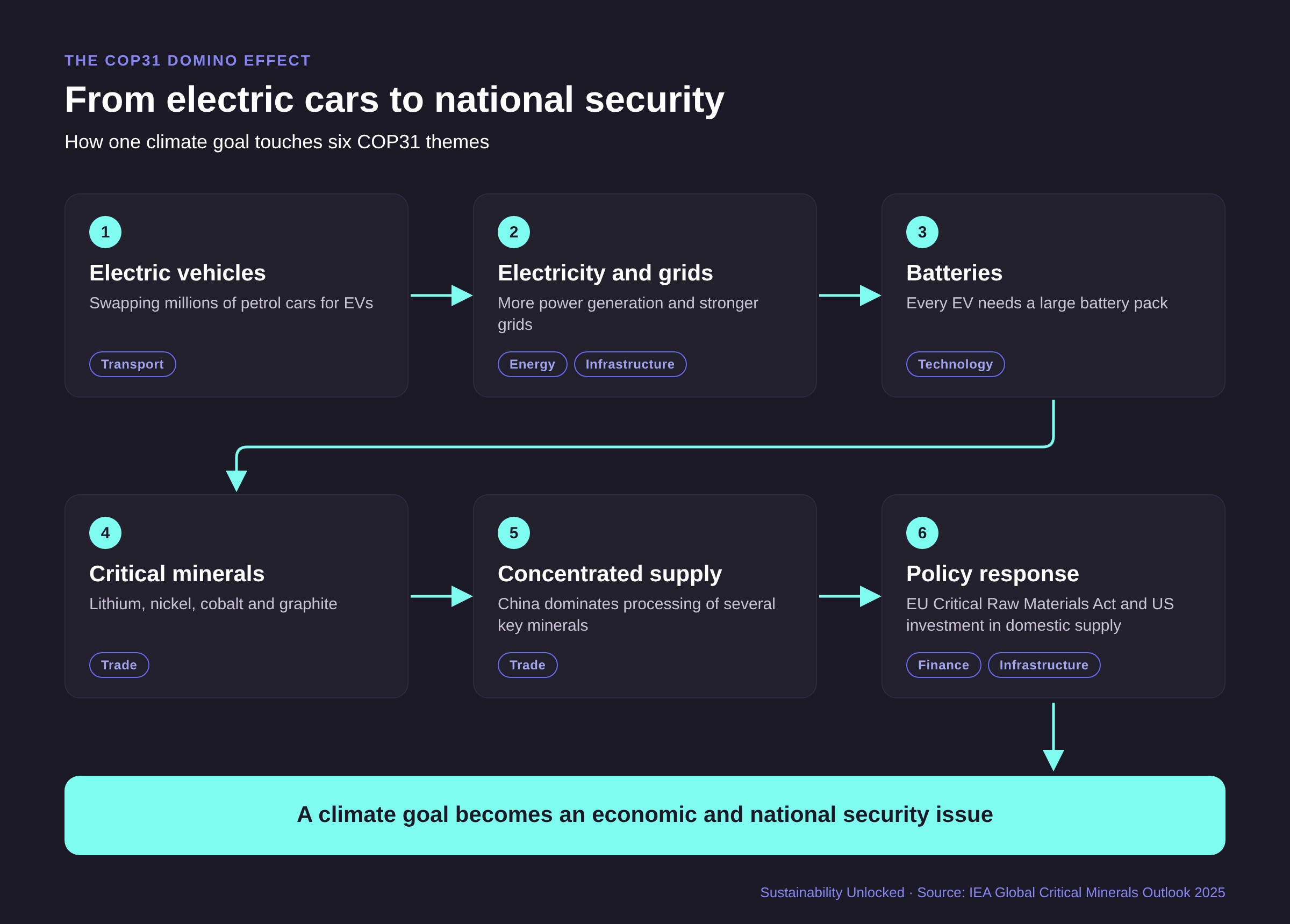
Let me give you an example of this domino effect. You cannot swap millions of petrol cars for EVs without more electricity, stronger grids and batteries. Producing those batteries requires critical minerals such as lithium, nickel, cobalt and graphite, whose supply chains are concentrated in a relatively small number of countries. China, in particular, dominates the processing of several minerals essential to the energy transition.
Suddenly, a climate initiative becomes a high stakes issue of economic and national security that forces defensive moves like the EU's Critical Raw Materials Act to reduce dependence on individual foreign suppliers, and massive US investments to secure domestic supplies.
Think about how fast that escalated. We started with electric cars and somehow ended up discussing China's mineral monopoly, European industrial strategy, and billions in infrastructure funding. Without trying, we just touched six COP31 themes: Transport, Energy, Technology, Trade, Finance, and Infrastructure. And that is before we even consider the land, water, and local communities affected by the actual mining.
This domino effect cuts both ways, not just in the solutions we build, but in the climate impacts we face. For instance, a prolonged drought can dry up rivers, which chokes off hydropower generation and stalls the barges that transport industrial goods. With less power and slower shipping, factories slow down, electricity costs spike, and grocery prices soar due to ruined harvests.
What began as a weather event quickly snowballs into an energy crisis, a food shortage, a supply chain breakdown, and a financial strain on everyday people.
Corporate executives are actively flagging this exact dynamic to their investors, and it is already showing up in their financial discussions. A new Goldman Sachs Asset Management analysis of earnings calls between 2021 and 2026 found that 68% of comments linking physical climate risks to financial impacts concerned revenue, compared with 17% relating to operating expenses. These figures reflect how often the impacts were mentioned, rather than the actual financial losses, but they show just how far the consequences of extreme weather can reach.
This is why the COP31 agenda has to be so massive. You cannot solve pieces of the puzzle in isolation, because every climate impact and every green solution is hooked up to the exact same global grid.
How could COP31 affect your business?
What gets decided at COP31 affects your raw material sourcing, energy procurement, technology investments, and regulatory compliance. Even if completely voluntary, the pledges made at COP31 can trigger a domino effect of local trade laws, investment and corporate pivots and bank and insurance conditions.
We are already seeing this shift in Europe. On 27 October 2026, the European Commission proposed its first Climate Resilience Law. The proposal asks member states to plan around physical climate risks using a common warming trajectory, including a 3°C scenario by 2100. That matters for business because resilience is moving from a broad policy ambition into something that could shape insurance, investment, infrastructure standards and national risk planning. In other words, companies may increasingly be expected not only to cut emissions, but to prove they can operate in a hotter, more disrupted world.
If adopted, the regulation would move quickly. The European Environment Agency would deliver its first comprehensive climate risk assessment by 30 June 2028, followed by an EU strategic resilience plan by 30 September 2028. Member states would then be expected to translate that direction into national resilience planning by 2030.
How could COP31 affect your role?
If you don't work in sustainability or finance, chances are you've never followed a COP summit closely. Because in the end, what do discussions between nearly 200 countries have to do with your day job?
Actually, a lot!
The connection isn't always obvious, but the consequences can reach businesses of every size and sector, and people in almost every role. To see ways in which it could affect your role, look at these hypothetical scenarios built around the three main areas where a business faces pressure:
1. Sourcing & Supply Chain Pressures
You are a procurement manager. The EU Deforestation Regulation (EUDR) will soon require companies placing cattle, cocoa, coffee, palm oil, rubber, soy or wood products on the EU market to prove they haven’t contributed to deforestation, with deadlines phased in by company size. UK businesses selling into the EU will feel it too, as their EU customers ask for proof. Forest pledges at COP31 could push more countries to follow. Now imagine your long-standing supplier cannot trace its products back to where they were grown.
QUESTIONS: Do you drop them or pay to upgrade their tracking? If you drop them, can your alternative suppliers handle the sudden volume? And if you keep them, how do you handle the months-long supply gap while their new tracking system is being built?
You are the import manager. From January 2027, the UK’s new carbon border charge applies to imported steel, and other governments are subsidising their own cleaner steelmakers. Suddenly, the steel you’ve imported for years costs more than buying locally, but you’re locked into a long-term supply contract.
QUESTIONS: Do you break the contract and face heavy legal penalties, try to renegotiate terms with a panicked supplier, or simply pass the extra costs on to your customers and risk losing them to cheaper domestic competitors?
2. Operations & Infrastructure Pressures
You are a truck driver. COP31 ends up with a pledge to rapidly phase out fossil fuel transport. Your company takes advantage of new incentives to replace some diesel trucks with electric ones. Now you need to consider battery range, charging stops and whether the charging infrastructure along your route can support your deliveries.
QUESTIONS: Do you push the battery to its limit to make the drop-off on time, or play it safe and take the heat for a missed deadline?
You are a facilities manager, imagine COP31 triggers strict new building decarbonisation laws. Executive leadership decides to completely upgrade your company’s head office. You need to replace the heating and overhaul the wiring without disrupting staff.
QUESTIONS: If the building’s power grid can't handle the new heat pumps, do you demand a massive budget upgrade from the board? If renovations run late, who pays for temporary office rentals?
3. Financial & Workforce Pressures
You are a finance director, imagine that you apply for a standard loan to replace old factory gear. Thanks to a COP31 climate finance pact, the bank refuses a good interest rate until you hand over a credible emissions reduction plan.
QUESTIONS: Do you hire expensive consultants to rush a plan, or swallow the higher interest rate? If your carbon cuts fall short next year, will the bank pull your funding entirely?
You are a Learning & Development Director, imagine your company decides to replace an old, emissions-intensive production line with cleaner, more automated equipment. Some employees have worked with the same machinery for 30 years, and many don't have the technical skills needed to operate the new systems.
QUESTIONS: How do you retrain experienced workers while keeping production running? What happens to employees whose jobs are no longer needed? And how do you manage all this with a limited training budget and a workforce worried about its future?
What should businesses do to prepare for COP31?
Start with exposure, not ambition: find where carbon rules, supplier traceability and financing conditions touch your business before 2027. Most of what COP31 sets in motion will reach you through your suppliers, regulators and lenders, so prepare for those three first.
Six steps to take now:
- Check your CBAM exposure. Map your suppliers of steel, aluminium, cement, fertiliser and hydrogen against the UK CBAM, which starts on 1 January 2027, and the EU CBAM.
- Test supplier traceability. Ask suppliers of timber, cocoa, coffee and other EUDR commodities whether they can trace products back to where they were grown.
- Update your contracts. Add emissions-data clauses to new supply contracts.
- Plan electrification carefully. Before electrifying buildings or fleets, audit energy use and grid capacity, and check which incentives follow COP pledges.
- Get finance-ready. Prepare a credible emissions reduction plan before your next loan or refinancing.
- Plan reskilling early. Identify the roles affected by new equipment and start training before it arrives.
These are the kinds of decisions that could eventually land on your desk after international climate negotiations. After seeing this, do you still think COP is just relevant for a select few?
If you want to explore these connections further, have a look at our pathway, COP31: What It Means for Business, and get a head start before some of these changes land on your desk.
It brings together fifteen expert-led videos, flashcards and case studies covering the summit's main themes, from energy and transport to finance, technology, nature and human rights, and what they could mean for businesses across different industries and roles.
COP31 FAQs
What is COP31?
COP31 is the 2026 UN climate summit, held in Antalya, Türkiye, from 9 to 20 November 2026. Nearly 200 countries meet to negotiate how to respond to climate change. Even voluntary COP31 pledges can change what businesses pay for energy, which suppliers they can use, how banks price loans and which rules apply.
Who is hosting COP31?
Türkiye hosts COP31 in Antalya, and its environment minister, Murat Kurum, is COP31 President. Australia's climate and energy minister, Chris Bowen, is President of Negotiations, with authority over the negotiating texts. It is the first COP to split presidency powers between two countries, a deal struck at COP30 when neither would withdraw its bid.
How is COP31 different from COP30?
Three things stand out. Two countries share the presidency for the first time. Climate is now framed as a security issue: Türkiye argues that wealthy countries should spend more on climate than NATO members have committed to defence. And the UN has signalled no "big-ticket" deals, so the focus is on delivering promises already made.
Do COP summits actually achieve anything?
Progress is slow, and emissions are still too high. But COP decisions set the direction for national laws, trade rules and finance. The 2015 Paris Agreement came out of a COP, and measures such as carbon border charges and deforestation rules serve the same goals. For businesses, the impact arrives through regulation and lending, not summit headlines.
What is CBAM, and does the UK have one?
CBAM, the Carbon Border Adjustment Mechanism, puts a carbon price on certain imports so they pay the same carbon cost as goods made locally. The EU's CBAM covers iron and steel, aluminium, cement, fertilisers, hydrogen and electricity. The UK launches its own on 1 January 2027, covering aluminium, cement, fertiliser, hydrogen, and iron and steel.
How far off track are global emissions?
According to UNEP's Emissions Gap Report 2025, current policies put the world on course for about 2.8°C of warming this century. Even if every national climate plan is delivered in full, warming would reach 2.3–2.5°C. Staying within 1.5°C would need emissions about 55% below 2019 levels by 2035.

Maria Coronado Robles
Share "COP31: What it means for your business" on
Latest Insights
El Niño: Everyone is talking about it. But what does it actually mean for your business?
1st October 2026 • Maria Coronado Robles

Sustainability training for employees: a practical guide for organisations
21st June 2026 • Learning Adviser