






Featured Pathways

More pathways

The Science of Climate Change

Climate change is no longer a distant threat or just a possibility, it is now a reality for all of us. In this pathway, Kevin Trenberth, a renowned climatologist, delves into the science behind climate change. He first introduces the climate system, its main components and forces.

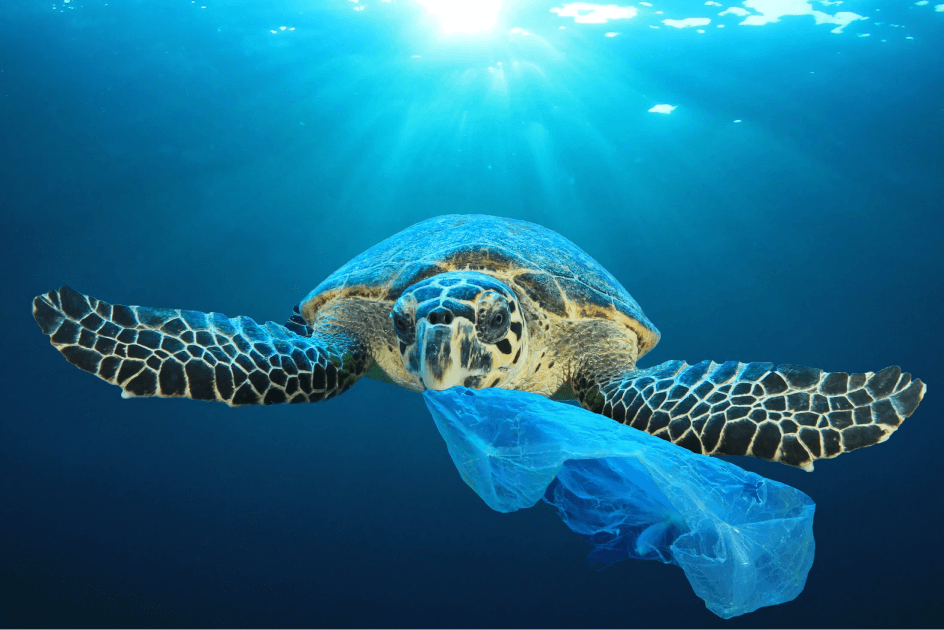
Tackling the Plastic Crisis

Plastic pollution is by far the biggest threat to our oceans and this remains an incredibly tough problem to solve. Plastic credits could potentially serve as one of the much needed solutions for this crisis.

More pathways

Book a demo

Ready to get started?

Our Platform

Expert led content

+1,000 expert presented, on-demand video modules

Learning analytics

Keep track of learning progress with our comprehensive data

Interactive learning

Engage with our video hotspots and knowledge check-ins

Testing & certification

Gain CPD / CPE credits and professional certification

Managed learning

Build, scale and manage your organisation’s learning

Integrations

Connect Sustainability Unlocked to your current platform

Featured Content

More featured content

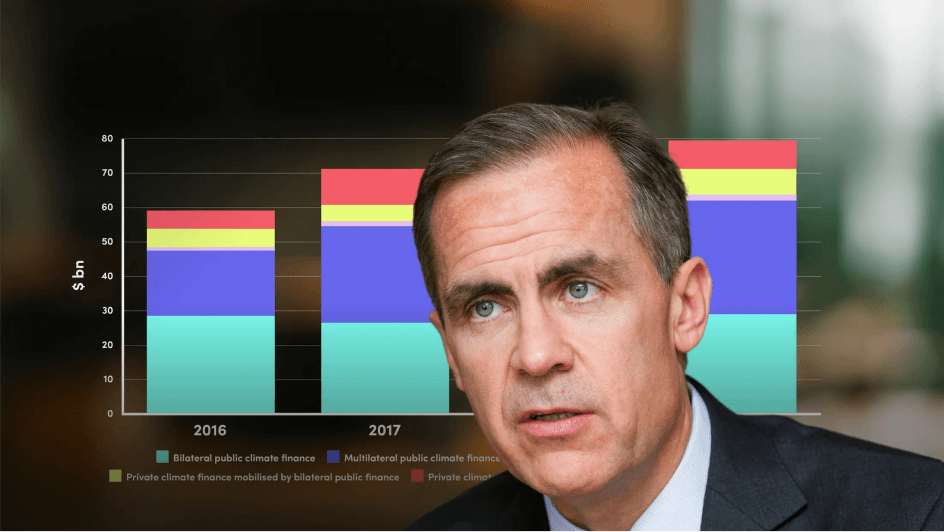
The Scale of the Net Zero Challenge

The price of meeting net zero is estimated to be between $100-150 trillion over the next 30 years. Regardless of this cost, we need to reach net zero before climate change does irreversible damage to the environment and the economy.

ESG, Sustainability and Impact Jargon Buster

ESG, sustainability, impact… they all just mean green, right? Not quite. Despite being used often interchangeably, there are distinct differences between these terms.

More featured content

Book a demo

Ready to get started?

Featured Pathways

More pathways

The Science of Climate Change

Climate change is no longer a distant threat or just a possibility, it is now a reality for all of us. In this pathway, Kevin Trenberth, a renowned climatologist, delves into the science behind climate change. He first introduces the climate system, its main components and forces.

Tackling the Plastic Crisis

Plastic pollution is by far the biggest threat to our oceans and this remains an incredibly tough problem to solve. Plastic credits could potentially serve as one of the much needed solutions for this crisis.

More pathways

Book a demo

Ready to get started?

Our Platform

Expert led content

+1,000 expert presented, on-demand video modules

Learning analytics

Keep track of learning progress with our comprehensive data

Interactive learning

Engage with our video hotspots and knowledge check-ins

Testing & certification

Gain CPD / CPE credits and professional certification

Managed learning

Build, scale and manage your organisation’s learning

Integrations

Connect Sustainability Unlocked to your current platform

Featured Content

More featured content

The Scale of the Net Zero Challenge

The price of meeting net zero is estimated to be between $100-150 trillion over the next 30 years. Regardless of this cost, we need to reach net zero before climate change does irreversible damage to the environment and the economy.

ESG, Sustainability and Impact Jargon Buster

ESG, sustainability, impact… they all just mean green, right? Not quite. Despite being used often interchangeably, there are distinct differences between these terms.

More featured content

Book a demo

Ready to get started?

Book a demo

Ready to get started?

Why Climate Governance Matters

Why Climate Governance Matters

Arun Kelshiker

20 years: Asset management and stewardship

In this video, Arun explores how governance, legislation, and litigation are reshaping the global response to climate change. He explains how these frameworks drive accountability, embed climate action into law, and influence industries, investors, and financial systems.

In this video, Arun explores how governance, legislation, and litigation are reshaping the global response to climate change. He explains how these frameworks drive accountability, embed climate action into law, and influence industries, investors, and financial systems.

Subscribe to watch

Access this and all of the content on our platform by signing up for a 7-day free trial.

Why Climate Governance Matters

7 mins 13 secs

Key learning objectives:

  • Understand how governance, legislation, and litigation shape the global response to climate change

  • Identify the economic and financial risks arising from physical and transition climate impacts

  • Understand how climate laws and disclosure requirements affect industries, investors, and financial institutions

Overview:

The worsening climate crisis is reshaping economies, societies, and financial systems through escalating physical and transition risks. Governance, legislation, and litigation now play central roles in driving accountability, embedding climate action into law, and ensuring justice and compensation. These frameworks influence sectors from energy to transport, while also reshaping financial markets through asset revaluations, defaults, and systemic risks. Case studies from Spain and the UK illustrate how ambitious climate laws and mandatory disclosure requirements push industries and investors to accelerate the low-carbon transition, reinforcing the link between regulation, resilience, and long-term financial stability.

Subscribe to watch

Access this and all of the content on our platform by signing up for a 7-day free trial.

Summary
How do governance, legislation, and litigation influence climate action?

They provide enforceable structures that integrate climate concerns into environmental, energy, and economic laws. Governance ensures coordination, legislation sets binding obligations, and litigation enforces accountability, compensation, and rights protections. Together, they accelerate the shift toward low-carbon economies and safeguard justice for those most affected by climate change.

What are the main risks posed by climate change to economies and finance?

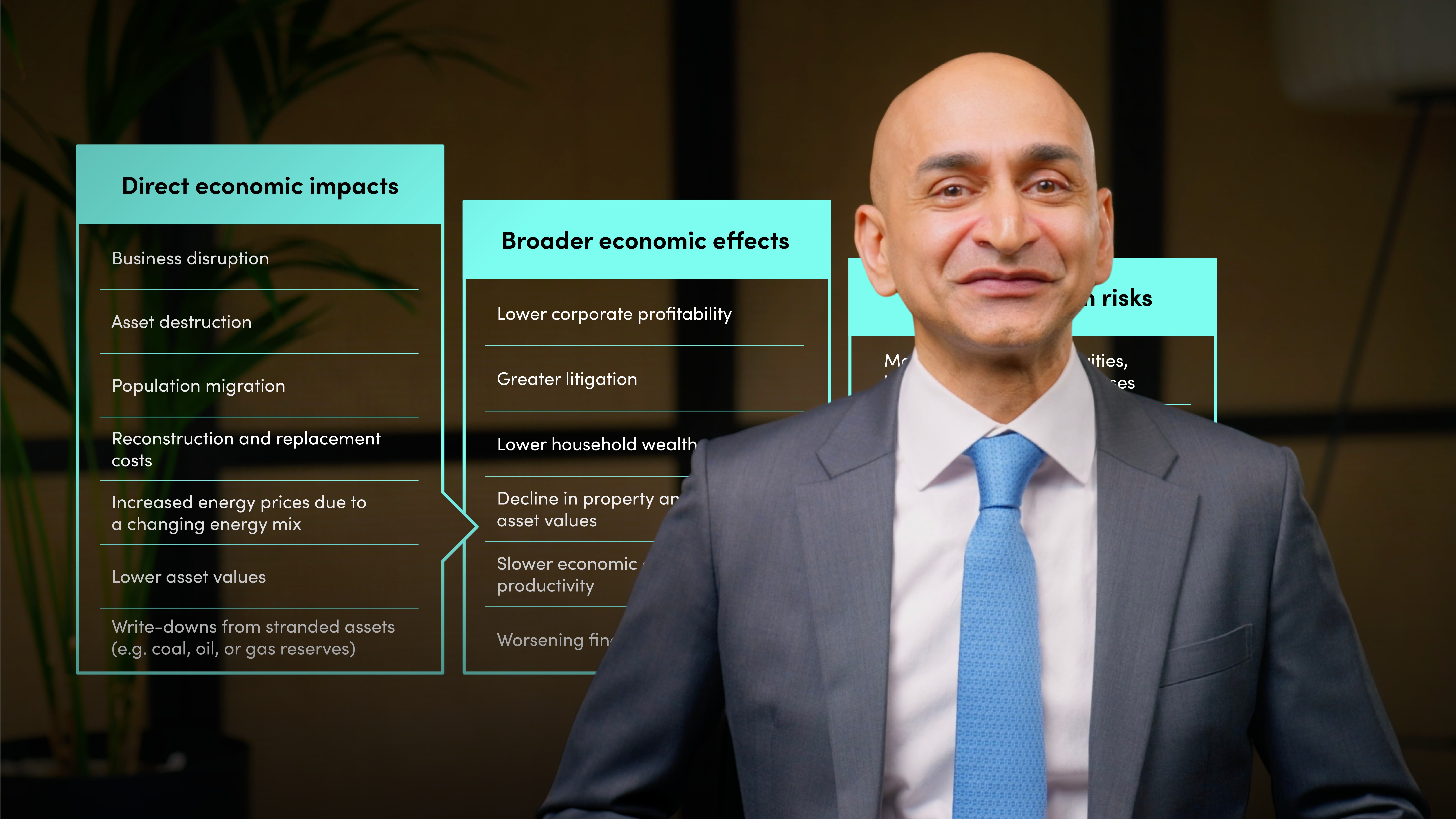
Physical risks include asset destruction, business disruption, and reconstruction costs following extreme weather events. Transition risks arise from regulatory shifts, technological changes, and evolving consumer preferences. Both channels erode asset values, increase defaults, and destabilise financial institutions, with feedback loops amplifying losses across equities, bonds, loans, and insurance.

What are the main climate-related risks to the economy and financial system?

Climate risks emerge through two main channels: physical and transition. Physical risks include extreme weather, floods, droughts, and heatwaves that disrupt production, damage assets, and increase insurance and reconstruction costs. Transition risks stem from the rapid policy, technology, and consumer shifts required to achieve a low-carbon economy. These create stranded assets, such as coal or oil reserves that lose value, along with higher energy costs, reallocation of capital, and structural industry changes. Together, these risks ripple across economies: reducing profitability, lowering property and corporate valuations, and driving litigation over climate liability. For financial institutions, this translates into heightened credit defaults in loan portfolios, declining asset prices in equities and bonds, rising underwriting losses, and operational risks. The compounding effect can destabilise the financial system, triggering feedback loops that worsen economic performance and intensify systemic risk.

How do case studies illustrate the real impact of climate governance?

Spain’s 2021 Climate Change and Energy Transition Law mandates emissions cuts, bans new hydrocarbon exploration, and sets deadlines for zero-emission vehicles, reshaping energy, automotive, and infrastructure sectors. The UK’s Pension Schemes Act of 2021 compels TCFD-aligned disclosures, pushing funds like Worcestershire Pension Fund to shift capital into low-carbon equities, forestry, and climate-focused strategies. These cases demonstrate how governance both steers economies toward decarbonisation and alters investment landscapes.

Subscribe to watch

Access this and all of the content on our platform by signing up for a 7-day free trial.

Arun Kelshiker

Arun Kelshiker

Arun Kelshiker was formerly the Head of Asset Allocation and Portfolio Strategy at Standard Chartered Bank and part of the bank's Global Investment Committee, where he provided investment advisory and multi-asset portfolio solutions. His focus is now with Cambridge Sustainable Investment Partners, which draws its expertise from the Resilience and Sustainable Development Centre at Cambridge University. He is also a university lecturer at the Frankfurt School of Finance and Management and is Vice Chair of the CFA UK's Inclusion and Diversity Committee and its Investment Committee.

There are no available Videos from "Arun Kelshiker"